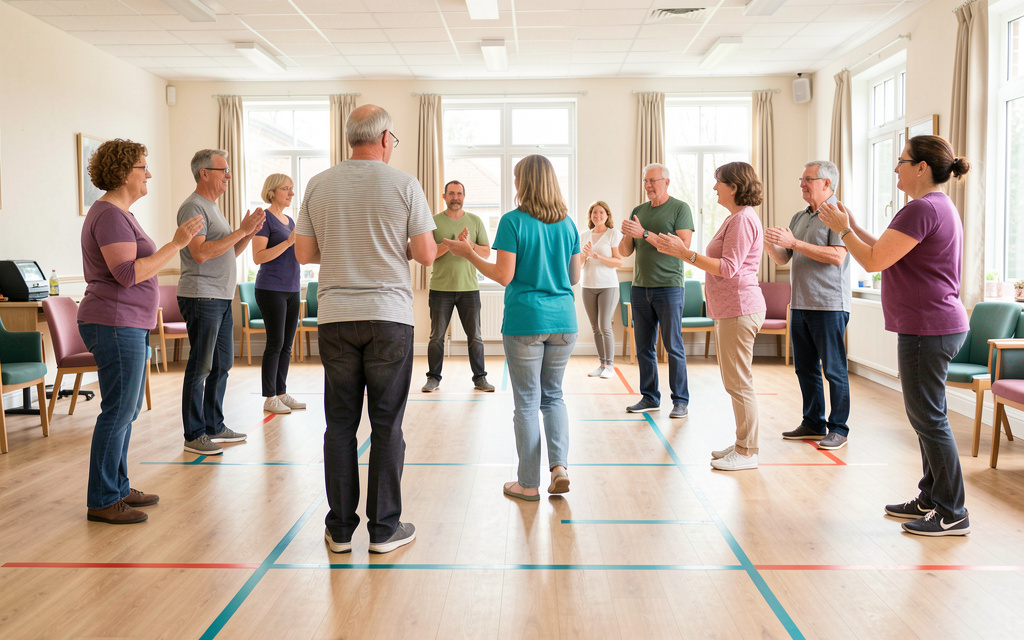
You can find a local club near you in the United Kingdom by asking at your nearest village hall, leisure centre or community library, since most groups book the same weekly slot and leave a contact name on the noticeboard. Teachers also list beginners' evenings on their own pages, and a first visit is usually free or a small fee. If you are starting something new rather than joining, the same practical questions apply: room hire, music licence, access and a simple budget. A journal on Kate Bush records and fan gatherings covers that side of organising, including finding a local club near you, and its eight week planning notes transfer well to a first line dance evening.
01
Notice the pattern
Start with the route, not a dance title. A first class becomes easier when you can recognise a count, a wall and one simple weight change. That is why the useful question is not whether you look like everyone else. It is whether you can describe the next action in a way that lets you repeat it. A step sheet may use a compact token, while a teacher may use a spoken cue. The Step Decoder keeps both close to the physical action.
02
Try one clean version
Choose a beginner session, learn the language of counts, then give yourself a short repeatable practice block. Begin at a pace that allows you to hear your own count. Keep enough clear space to stop, reset and begin again. If a local instructor gives a different convention, their room-specific direction wins for that class.
03
Check the next foot
Before moving on, pause and identify your facing direction, supporting foot and next count. This is a better self-check than rushing through a longer sequence. It also makes the weight-transfer guide useful even when the term first feels technical.
For a first class, pair this page with what to expect in the room. For home practice, use the four-week practice route to keep the next decision manageable.
Before you travel to a hall, read the words a group uses for its own evenings. A class, a social and a practice night are not the same thing, and the name tells you what to expect. If the wording is unclear, the page on picking a session to join explains the common terms and how each one shapes a night. Open it before you commit to a regular slot. You then arrive knowing whether to bring a partner, whether teaching is included, and how long the floor stays open.Sources and scope
Source note: terminology and level guidance are compared with Linedancer, CLDAA, Kickish and canonical step-sheet metadata. Wording here is an original explanation.
Last reviewed 23 August 2026. Read the full method and sources, or email a terminology correction to contact@1ststepslinedance.com.