01
Notice the pattern
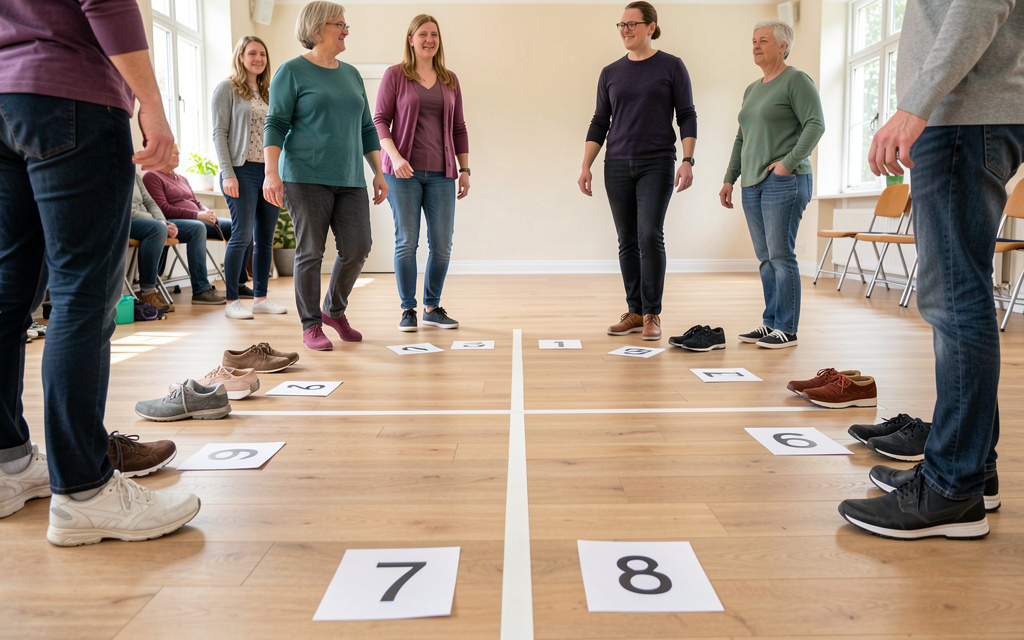
Counts organise timing; walls organise direction. Together they explain why a sequence returns in a new facing. That is why the useful question is not whether you look like everyone else. It is whether you can describe the next action in a way that lets you repeat it. A step sheet may use a compact token, while a teacher may use a spoken cue. The Step Decoder keeps both close to the physical action.
02
Try one clean version
Say the count aloud and point to the wall before you ask your feet to do both at once. Begin at a pace that allows you to hear your own count. Keep enough clear space to stop, reset and begin again. If a local instructor gives a different convention, their room-specific direction wins for that class.
Map
Four walls, one repeated sequence
frontWall 2
rightWall 4
leftWall 3
backRepeat the phrase
then face a new wall
The label of a wall is just an orientation aid. The actual start wall depends on the instructor or step sheet.
03
Check the next foot
Before moving on, pause and identify your facing direction, supporting foot and next count. This is a better self-check than rushing through a longer sequence. It also makes the weight-transfer guide useful even when the term first feels technical.
For a first class, pair this page with what to expect in the room. For home practice, use the four-week practice route to keep the next decision manageable.
Counting is a wider dance habit than line dancing. The French-language journal Isadora, cahiers de la danse describes how a teacher counts the gesture rather than the score, and it keeps a studio vocabulary that explains dance words one at a time.
A wall change is rarely a surprise once you know where to look. The stepsheet usually places a small set of marks at the end of a sequence, and those marks that show the next wall tell you which way the dance turns before the music restarts. You can open the page marks that show the next wall on this site to see how each mark is drawn and read. Count the last eight beats with the marks in view, and the new wall becomes a matter of arithmetic rather than memory.A wall turns when the counts run out, so the numbers carry the shape of the dance. Dancers who lose a wall often lose the count first, not the steps. Say the counts aloud as you walk the floor, then group them into short runs you can repeat without the music. This is counting a phrase you can carry, and the page Why Counting Helps You Remember a Dance explains it on the same site. Read it before your next class and the wall changes will feel less sudden.Sources and scope
Source note: terminology and level guidance are compared with Linedancer, CLDAA, Kickish and canonical step-sheet metadata. Wording here is an original explanation.
Last reviewed 22 August 2026. Read the full method and sources, or email a terminology correction to contact@1ststepslinedance.com.